The execution of the Forest Brotherhood conspirators
Doctor ZhivagoThe execution of the Forest Brotherhood conspirators is a mass killing carried out against eleven accused ringleaders and two male nurses, condemned for brewing vodka. On a remote forest platform, a guarded procession turns into a scene of panic and failed protest before the condemned are shot. The episode’s significance lies not only in its outcome but in the conduct surrounding it: the guards’ former comradeship briefly restrains them, while Vdovichenko’s last speech recasts the condemned as martyrs to ideals that the new revolutionary authority has betrayed.
Setting and sentence
The condemned are taken one cold morning to a high stone platform in the forest. Its edge is ringed with upright granite boulders, which Yurii Andreievich had thought might bear the marks of human hands and have served as an ancient shrine. The place’s monumental, uncertain character frames the execution: a site that seems to belong to a distant past becomes the stage for a present political sentence.
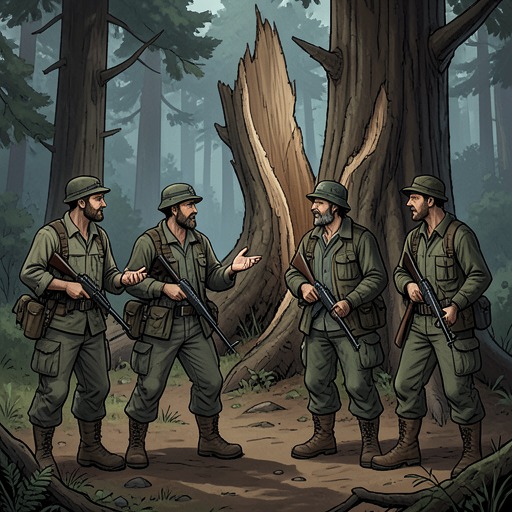
Twenty loyal partisans, including members of the commander’s bodyguard, escort the prisoners. The guards form a semicircle and drive the condemned toward the platform’s edge, where the precipice leaves no way out. The accused include eleven alleged conspiracy ringleaders and two male nurses sentenced for brewing vodka. The scene thus brings together political punishment and a separate offense, under a procedure in which the condemned have already endured questioning, imprisonment, and maltreatment.
A failed intervention
The execution is interrupted when Rzhanitsky, an old anarchist and friend of Vdovichenko, suddenly fires three shots at the guards, aiming at Sivobluy. He misses. The guards do not immediately attack or shoot him; their hesitation is attributed to tact and pity for former comrades. That moment of restraint does not stop the execution, but it reveals that the opposing sides are not simply strangers: political conflict has divided people who share a past.
Rzhanitsky still has three bullets in his revolver, but, maddened by his failure and perhaps forgetting them in his agitation, he throws the weapon against the rocks. It discharges again and wounds Pachkolia in the foot. Pachkolia cries out, and Pafnutkin and Gorazdykh lift him and drag him by the arms so that the crowd will not trample him. The injury and the effort to keep him from being crushed intensify the disorder without changing the prisoners’ fate.
Panic and protest
As the condemned are driven forward, fear breaks through the attempted order of the procession. Galuzin, still wearing his yellow-braided school cap, removes it, falls to his knees, and backs away with the others while pleading with the guards to spare him. He says he has not yet lived and wants to see his mother once more. His appeal turns the abstract category of a condemned conspirator into a young person facing death and separation from his family.
Other prisoners denounce Sivobluy as a traitor, accusing him of betraying both the lawful Tsar to whom he had sworn an oath and the comrades to whom he later pledged loyalty. Their accusations enlarge the confrontation beyond the immediate sentence: the executioners themselves are challenged as oath-breakers, and loyalty is presented as something repeatedly betrayed across political regimes.
Vdovichenko remains composed at the edge of death. Addressing Rzhanitsky as a fellow anarchist, he tells him not to humble himself and argues that protest will not reach the new executioners. He insists that history will tell the truth and predicts that posterity will condemn the commissarocracy for its deeds. His final declaration presents the prisoners’ deaths as martyrdom for their ideals and ends with a call for world anarchy. The speech does not avert the sentence; its force instead lies in setting the condemned men’s claim to historical vindication against the authority that is killing them.
The volley and its aftermath
The guards fire a volley of twenty shots at a command audible only to the riflemen. Half the condemned fall, most killed outright; a second salvo kills the rest. Galuzin is the last to stop moving. The execution closes the immediate possibility of appeal or escape, while the preceding pleas, accusations, and final speech remain as distinct responses to the same irreversible act.
The episode makes the execution an enactment of revolutionary power, but not a seamless one. The guards’ initial reluctance to attack an old comrade, Rzhanitsky’s unsuccessful intervention, and Vdovichenko’s appeal to future judgment expose the human and ideological divisions inside the partisan ranks. The firing settles the prisoners’ fate, yet the promise that history will tell the truth leaves the legitimacy of the sentence contested rather than resolved.